Showing posts with label PAS. Show all posts

Wednesday, January 10, 2007

Child / Parent Access Interference: New York Court removes custody from mother.

I have written multiple posts about a lack of federal policy in Canada on child-parent access issues. There are still no accessible, affordable and timely remedies to incidents of access interference in cases of divorce with children. In Canada, these situations invariably require the involvement of the court initiated by the 'victim' who is required to do a "private prosecution" to find accountability (with their own after-tax funds). If not, child-parent relationships suffer.

Nevertheless, when one can help to finance judicial accountability mechanisms to the finish line, there can be justice. Late last week in New York State, a mother lost custody of her child for not having allowed that child to have meaningful access with the child's father.

Although this type of accountability should be as common as is "access interference" itself, the Supreme Court of New York reversed custody and awarded it to the father. New York attorney Daniel Clement writes: "While the Court's decision does not detail exactly what the mother did, the decision evidences that there is a growing judicial intolerance of one parent interfering with the other parent's visitation rights." The decision is published here.

There are precedents in Canada. In January 2005 a similarly striking adjudicated response happened in an Ontario Court. Justice Lorna Snowie fined a mother $10,000 and another $15,000 sentenced her to 30 days in jail and reversed custody for not encouraging her 16-year-old daughter to participate in family counselling aimed at helping her reconnect with her father after many years of access denial.

From a policy perspective, what needs to happen is this: institutions need to also be created to enforce meaningful access between children and both of their parents similar to those already set up to enforce the payment of child support.

Thursday, January 04, 2007

Part 3: Judicial Review: Is there a relationship between bias and Supreme Court appointments?


In my post on New Year’s Day I chose to share with the Liblogs and Progressive Blogger communities confidential data just released that in essence shows a judicial bias at the Ontario Court of Appeal. The post generated allot of hits, some exceptional enthusiasm, some comments, some skepticism, and some indifference.

I especially appreciated those wanting to know more details, such as Canadian Tar Heel, Anonymous Gayle and Devin. Gayle and Devin concluded with the information I had provided that the study was “flawed”. We had it out a little bit in the comments section of the post. In the end I disagree with what I consider to have been pre-mature conclusions. Nevertheless, we can agree to disagree, which is perfectly fair. Healthy skepticism keeps the world moving. It would be good to know if after this post we still disagree.

As for the very skeptical and borderline belligerent, “decoin”, there is a case at the Court of Appeal today that is using this report as evidence.

I may have been short-sighted in identifying as an example only Supreme Court Justice Rosalie Abella’s discrimination rating. Another former Ontario Court of Appeal Justice with almost as bad a discrimination rating was appointed by then Justice Minister, Irwin Cottler, to the Supreme Court of Canada on the same day in 2004 as Justice Abella.

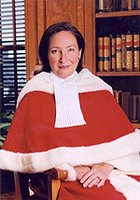
If you refer back to the results that I posted on January 1, Justice Charron was not far behind Justice Abella on the gender report's discrimination rating. Justice Charron favoured women over men 62.6% of the time, which is considered “heavy discrimination also. Her results in brief are as follows:

For Charron JA D = 70.0 - 7.4 = 62.6 % (heavy)

Wikipedia has this to say about Justice Charron:

Charron (born March 2, 1951 in Sturgeon Falls, Ontario) is a Canadian jurist. She as appointed to the Supreme Court of Canada in October, 2004, and is the first native-born Franco-Ontarian Supreme Court judge. (This distinction has sometimes been ttributed to Louise Arbour, but Arbour was born and raised Québécoise.)

Charron received a Bachelor of Arts degree from Carleton University in 1972, her Bachelor of Law degree from the University of Ottawa in 1975, and was called to the Bar of Ontario in 1977. She practiced civil litigation, and then joined the Crown Attorney's office in 1980, and then became a law professor at the University of Ottawa. She was appointed to the district Court of Ontario in 1988, and to the Ontario Court of Appeal in 1995. She is eligible to sit on the bench until 2026 when she reaches age 75.


I am sensitive that interested bloggers may like more information on how to define a win, the difference between pure wins and partial wins, and the number of men versus women who made these appeals. The following is an extraction from another report called “Judicial Bias at the Court of Appeal I”, which used “quick law” to consider the cases that were before Justice Abella and Justice Charron over time.
"For Justice Abella the total cases can be summarized as follows:

Appellant, Number, Win All, Lose All, Win/Lose Some
Male, 28, 2, 23, 3
Female,13, 10, 2, 1

It can be concluded a man had a 82.1 % chance of losing on all issues, but a woman had a 84.6 % chance of winning on at least some issues when appearing before a panel with Justice Abella on it

For Justice Charron the total cases can be summarized as follows:

Appellant, Number, Win All, Lose All, Win/Lose Some
Male, 27, 3, 22, 2
Female, 10, 7, 2, 1

It can be concluded a man had a 81.5 % chance of losing on all issues, but a woman had a 80.0 % chance of winning on at least some issues when appearing before a panel with Justice Charron on it"
Please let me know if more information is required to show the legitimacy of this research at this time. Otherwise, I would like to know whether there is an interest, or just apathy in looking further as to whether our judiciary is upholding its Charter obligations with respect to gender neutrality or not.

Monday, January 01, 2007

Part 2: Judicial Review - Data from 10 year study proves a judicial bias


I have written some posts in the past relating to current events that arguably demonstrate a gender bias in Canada’s Superior Courts. If there were any doubt still, last week I got the hard evidence.


I received these data from a reliable source who shall remain anonymous for now. These data represent a brand new ten year study called “Judicial Bias at the Court of Appeal III”. The study is being presented via a motion this week at the Court of Appeal. The motion requests that the court declare itself a “non-independent and impartial body“.


Do I have an obligation to share this evidence even if names of certain esteemed jurists are mentioned? Some say “yes“, while others warn about this exercise being too specific. I conclude that since all information is in the public domain, there is nothing wrong with presenting it to the public a more organised version of this same information. Plus, let's start off the year and the 60th post at Views from the Water's Edge with the universal themes of "fairness" and "accountability". For those behind creating the methodology, preparing the data and organising this research, thank you for your efforts.


The methodology seems logical and the results are no less than SHOCKING. These data show some level of discrimination on the part of ALL TWENTY TWO judges tracked between 1996 and 2006. Perhaps more shocking is that there is “heavy/high” discrimination by more than 75% of these judges. Not one judge favoured men over women over time, the closest being Justice Laskin who ruled in favour of women 8.6% more often than for men.


Now, before I say anything more, I would like to remind all readers of the pertinent sections of our dearest Charter of Rights and Freedoms:

Equality Rights Equality before and under law and equal protection and benefit of law 15. (1) Every individual is equal before and under the law and has the right to the equal protection and equal benefit of the law without discrimination and, in particular, without discrimination based on race, national or ethnic origin, colour, religion, sex, age or mental or physical disability. 28. Notwithstanding anything in this Charter, the rights and freedoms referred to in it are guaranteed equally to male and female persons.


The methodology of the study is described below:

This study analyzes the decisions of 22 judges at the Ontario Court of Appeal. It is an extension of the 2 previous studies, Judicial Bias at the Court of Appeal I and II. This study traces differences in decisions based on the sex of the appellant, as can be determined by judge, issue, and year. Over 800 decisions on the public records of judges of the court are included. All the available family law entries from the Canlii database for Ontario Court of Appeal were used. Specific cases are listed by judge in Appendix A, and by year in Appendix B, from 1996 to 2006.


Part one of the study is called “Discrimination by Judge”.


“Discrimination indexes are used to compare the differences between judges. Discrimination indexes are defined as ; D = % female wins - % male wins. A negative value would indicate discrimination against females, and a positive value, discrimination against males. Specific values for 17 of the justices were computed in the earlier studies Judicial Bias at the Court of Appeal I and II and the data is included in Appendixes 1 to 17. The values for the remaining 5 judges were derived from Appendixes 18 to 22 using the same techniques. Procedural issues, penalties, equalization, costs, and issues generally designated as other are not included in this analysis. Discrimination categories have been assigned as : 0 to 15 % is slightly discriminatory, 15 to 30 % is moderately discriminatory, 30 to 60 % is highly discriminatory, 60 to 85 % is heavily discriminatory, and 85 to 100 % is fully discriminatory.”


The key results are as follows:


D = % Female Wins - % Male Wins, Discrimination count, Category

For Abella JA D = 76.5 - 6.4 = 70.1 % (heavy)
For Feldman JA D = 72.7 - 13.3 = 59.4 % (heavy/high)
For Charron JA D = 70.0 - 7.4 = 62.6 % (heavy)
For Simmons JA D = 80.0 - 23.8 = 56.2 % (high)
For Lang JA D = 50.0 - 0 = 50.0 % (high)
For Wheiler JA D = 77.8 - 26.1 = 51.7 % (high)
For McMurtry CJO D = 69.9 - 40.0 = 29.1 % (moderate/high)
For O’Connor DCJO D= 80.0 - 30.0 = 50.0 % (high)
For Goudge JA D = 77.8 - 39.1 = 38.7% (high)
For Borins JA D = 70.0 - 27.3 = 42.7 % (high)
For Rosenburg JA D = 71.4 - 33.3 = 38.1 % (high)
For Armstrong JA D = 66.7 - 26.3 = 40.4 % (high)
For Moldaver JA D = 52.6 - 6.7 = 45.9 % (high)
For Macpherson JA D = 62.5 - 14.3 = 48.2 % (high)
For Gillese JA D = 85.7 - 50.0 = 35.7 % (high)
For Juriasz JA D = 60.0 - 0.0 = 60.0 % (high/heavy)
For Blair JA D = 50.0 - 9.1 = 41.9 % (high)
For Cronk JA D = 66.7 - 42.1 = 24.6 % (moderate)
For Sharpe JA D = 33.3 - 11.7 = 21.3 % (moderate)
For Catzman JA D = 63.6 - 43.7 = 19.9 % (moderate)
For Labrosse JA D = 61.5 - 45.0 = 16.5 % (moderate)
For Laskin JA D = 55.5 - 47.0 = 8.5 % (slight)

There you have it. And, these data were made available to you first. Oh yeah, did anyone else notice that one of the worst offenders of gender discrimination in this study is Rosalie Abella at 70.1%? Justice Abella is no longer a judge at the Ontario Court of Appeal because former Prime Minister Paul Martin appointed her to the Supreme Court of Canada in 2004.

For those who don’t know, Wikepedia explains the following about Justice Abella: “Abella was born in a displaced persons camp in Germany, and moved to Canada with her family in 1950. She graduated from the University of Toronto Law School in 1970, and practised civil and family law litigation until 1976, when she was appointed to the Ontario Family Court, becoming the youngest and first pregnant judge in Canadian history. She was then appointed to the Ontario Court of Appeal in 1992.”

What are my personal recollections of Justice Rosalie Abella’s contributions as a jurist?… I recall her having turned family law "upside down" by recognising the need to have “independent legal advice” for a separation agreement to be binding. Arguably, this was the catalyst for a huge “make work project” for the legal industry in family law. More recently, her fingerprints were all over a couple troublesome 2006 Supreme Court decisions, one of which was retroactive child support.

There is much that can be written about Justice Abella, which will have to wait until another time. However, in the meantime I can’t help but wonder whether persons will need to account for failing grades when it comes to gender bias in our judiciary?

Sunday, December 17, 2006

Judicial Review: Exploring how judges and lawyers survive in a biased system.


Judicial appointments can be as partisan in Canada as in the United States. Judges tend to be appointed also for political reasons.

Ontario Superior Court appointees are responsible for presiding over areas of law in which they may have little or no experience. When criminal or civil lawyers are appointed to the Superior Court of Ontario, they also will oversee a certain percentage of Family Court cases.

How is this working out and does this help or hinder the administration of justice? The Family Court raises a controversy, because of alleged Charter violations that are built into its existing procedures, which also fall under the jurisdiction of the Superior Court.

Is it possible to explore the successes and failures of judges in a random way? In theory yes, because it is all in the public domain. Some of it is organised in Canlii.

Judges, especially those who are appointed for being more political and less meritorious, are sometimes criticized for their decisions. Is this because of the rules, because they are too political or because they have too much discretion within legal procedure? It is hard to say.

With family policy and its administration by provincial courts being arguably Canada biggest social problem at the moment, it is important to also consider the role of judicial appointments.

Here is one scenario:

The Honourable Justice Roydon Kealey was appointed to the Ontario Superior Court in 1996 by the Attorney General and Justice Minister, Allan Rock. Kealey, an expert in legal accounting, criminal procedure and general litigation, takes on his share of family law cases.

Whether it is by accident or a part of Ottawa Master Beaudoin's process, Mr. Kealey seems to end up with at least his fair share of "unrepresented" fathers in family court for various reasons. He is also no stranger to the appeal, such as this case involving former NHL player Chris Simon, and this case involving lawyer Hunter Phillips of MacKinnon Phillips, who represented the mother.

I am aware of more than one 'unrepresented' father case before Justice Kealey where the mother's lawyer is (Aharon) Ron Paritzky, who practices with Mr. Hunter Phillips at MacKinnon Phillips. Because lawyers like Mr. Ron Paritzky and Mr. Hunter Phillips are effective in using legal procedure to their clients' advantage, they seem to have developed an expertise in extracting 'costs' from child support paying fathers who represent themselves in court.

This is almost always because self-represented fathers lack the appropriate financial resources to have access to appropriate representation and justice, even if they make too much to be eligible for legal aid. After all, Ontario's Family Responsibility Office has estimated that as much as 90% of child support flows upon gender lines from men to women because of how custody is awarded. This is in spite of the Charter of Rights and Freedoms.

This is in part because MOST men pay their child support in after tax dollars and MANY then cannot afford representation costs in after tax dollars also to ensure visitation with their children. This is in part why close to 40% of divorced dads are denied any visitation to their children. For many it is not affordable to enforce access, after they have paid their taxes and child support, which legislatively are priority expenditures that will be enforced by publicly funded insitutions.

In contrast, women of a certain ethical strain can dip into their child support (tax free) to ensure they are always well represented. This is a minority of mothers but a statistically significant proprtion nevertheless. Furthermore, for some strange reason, monies spent to collect child support (mostly by mothers) are tax deductable unlike monies spent (mostly by fathers) to ensure reasonable access, which are 100% taxable. This typically means $1 to lawyer and $1 to the tax department.

Let's face it, fathers need to be in the highest tax bracket to have a reasonable likelihood of scraping together a retainer, without selling the "farm" - assuming there is one after the divorce - and/or the "soul". There is no dignity in that.

For lawyers of this type, who focus on legal procedures, female clients tend to be more profitable. Mr. Paritzky and Mr. Phillips know which clients have the money available to dispose on litigation and which do not. Is this within the rules? Yes. Is anything wrong with this? That is a more complicated ethical question.

In assessing how to fix Canada's broken family law system, is it best to look at only the federal and provincial systems, or do we need to also evaluate the Judges (like Roydon Kealey) and the lawyers (like Ron Paritzky and Hunter Phillips)? Or, do we need to consider how all of the aspects have contribute and maintained the problems with the family court system?

This is a chicken and egg type situation. Is Justice Kealey contributing to a broken family law system? Is biased procedure created by lobbying from special interests beyond Justice Kealey's control? Are Ron Paritzky and Hunter Phillips simply making an honest living by doing what the system will allow? Should they be blamed for continuing to profit from well funded moms who need vigorous advocates to ensure their child support monies continue to flow and that they will always remain the primary parents?

Equitability standards will in time eliminate the gender biases, even though children and second families suffer in the meantime - and special interests continue to profit.

If anyone disagrees with me that this should be on the agenda for change by the "new" Liberal party, I would like to hear from you.

Otherwise, I trust those Liberals who still yearn for a just and fair society will speak up at the appropriate time and support change in family policy at both the macro and micro levels.

Thursday, October 19, 2006

Gender Discrimination in Ontario Family Courts: #1 public policy failure in Canada today

It is really too bad that in a progressive society with a Charter of Rights and Freedoms - the envy of the world - that grave injustices frequently occur to parents and children.

Believe it or not, gender discrimination currently exists in Canada's family courts. Many people laugh it off rather than deal with the hypocrisy. Others are simply not surprised.

Ontario is particularly bad. The rules that govern the judges and the institutions that get funding at the expense of forgotten priorities make it so that parents are treated differently because of their gender, and children suffer.

A few weeks ago I wrote how this bias in Ontario could affect Tie Domi and his children in a very negative way. Today, I am saddened by the Toronto Star's article Wednesday suggesting that two children would still be alive if it weren't for such a recklessly patriarchal system.

Canada's family policy and laws have failed and are brutally out of balance. Family policy is Canada's BIGGEST international embarrassment undermining the sheer credibility of our dearest Charter.

Perhaps Dalton could do his part to help reform the laws that negatively affect more than 50% of Ontario's population even though powerful lobbies still demand the status quo.

Family law is a joint jurisdiction: justice is administered by the provinces. At a later date I will focus on the federal responsibilities. For now, this blog is long enough because this article that reports this tragedy is all important and why those who long for a just society must speak up.